Organizations increasingly continue to rely on project-based work to drive innovation and achieve strategic objectives. As businesses and Project Managers rely on technology to manage their projects, automated project management tools will become increasingly important in ensuring project success.
Technology continues to provide an overcrowded set of project management tools and environments with a good purpose in mind, however it can be too complicated and can be so inclusive and provide too many places and multiple sets of information to handle effectively.
Regardless of the specific software you choose, here are four key aspects to consider in your work to help you be more successful.
To be more successful as a Project Manager, consider focusing and working more closely on these key aspects of project delivery:
The use of project management tools to support project planning, execution, monitoring and control to improve efficiency, collaboration, and decision-making is helping to streamline project workflows and processes. Ultimately, helping to improve outcomes. Automated project tracking tools enable Project Managers to better focus their valuable time on the critical work items that require attention and will continue to evolve and free up a Project Manager’s time from the mundane tasks checking, reminding or reporting, that can be accomplished using the proper tools and approach.
Dropping the simple spreadsheets… to use more advanced and automated tools, doesn’t have to mean the work needs to be more complicated.
Dropping the simple spreadsheets, documents, and forms and using more advanced and automated tools doesn’t mean the work needs to be more complicated.
A number of project tracking software applications continue to grow to be all-encompassing for many different roles and across multiple business areas. They are seemingly trying to be all things to all people and groups. Look for a move towards reduced complexity and a fit-for-purpose approach, directly linked to the specialized role of the Project Manager, to deliver projects. This reduced complexity will result in more focused work streams for all involved, and the responsibility and control of the project will be comfortably and confidently in the Project Manager’s hands.
Notifications of the latest updates from individuals are also important aspects of online project management tracking software.
Project tracking automation tools efficiently organize all the critical project information (that supports the project plan) in one place. And it’s not just Project Managers that benefit from more automated and focused project tracking and task management tools. Project team members can benefit from personalized workspaces enabling real-time access and tools that provide project visibility to anyone who needs it.
Automated alerts to pending deadlines, along with notifications of the latest updates from individuals, are also important aspects of online project management tracking software. This real-time sharing of information enhances communication. Timely project status reporting and visual project dashboards encourage open and transparent communication between project team members and stakeholders.
Remote work and distributed teams remain in place. It is increasingly important for Project Managers to have tools that easily enable “autonomous” communication and seamless team collaboration during project delivery. Autonomous project collaboration tools allow team members to work on their own as needed, while being aligned, and collaborating and engaging with the other team members and their ongoing work.
Features of project collaboration tools include real-time chat, document sharing, collaborative project workspaces, and individual project dashboards for team members. Personalized work reminder notifications and due-date alerts are also featured.
Project Managers will find they have less need for meetings.
Project Managers will need to develop strategies to effectively connect and manage remote teams and leverage easy-to-use project management collaboration tools with features that allow team members to be more efficient and productive. Autonomous project collaboration tools allow the team and key stakeholders to share information and engage at a level that fits their availability and timing. This includes team members in different time zones who can access their own workspace and responsibilities at any time and provide action and task updates in real time.
With the right project collaboration tools, Project Managers will find they have less need for meetings. With team members doing their own updates online, team update meetings can be shorter, more productive and be very focused on specific areas like problem solving, continuous improvement and new ideas. With less time needed for meetings, this also means Project Managers can be more focused on the priority work items that need their attention.
If meeting facilitation is done properly … this can actually be a competitive advantage.
For team collaboration to be successful, it involves a common or collective view of the project work. Some project management tools are well suited to sharing information in a group setting, on a shared screen. With the right project tools, team communication improves and there is a shared greater understanding of all the work going on. This supports better decision-making and seamless handoffs within the framework of the project. If done properly within an organization, this can actually be a competitive advantage.
A tailored approach to project management is one in which the Project Manager customizes their management techniques and strategies to fit the specific needs and goals of a particular project. Selecting and tailoring the project approach for the organization, the project and the ongoing improvements, is a key topic covered in the latest PMI Project Management Book of Knowledge 7th Edition. This tailored project and process delivery approach is in contrast to a one-size-fits-all approach, in which the same management techniques are used for all projects regardless of their unique characteristics. From the project requirements to budgets, risk management, communications and more, a tailored approach can be applied to suit the organization, the project, the sponsor or client.
A tailored approach to project management… increases the chances of project success.
There are several benefits to adopting a tailored approach to project management. First and foremost, it increases the chances of project success. This is because the Project Manager or organization is able to identify and address the specific challenges and opportunities presented by the project, rather than trying to fit the project into a predetermined management framework.
By involving stakeholders in the project management process, and tailoring the approach to meet their needs, stakeholders are more likely to feel invested in the project and committed to its success. A reminder that, as the ‘standard’ approach is altered, there needs to be an understanding by all stakeholders regarding how the project will deviate from the ‘standard’ way. More specifically, how the tailored approach affects their role and any aspect of the ‘standard’ project delivery.
In these situations, it is important to capture and record all of the project learnings.
When the project management approach is “tailored” within any organization, Project Managers have an opportunity to provide valuable information, to learn and improve from each tailored project. In these situations, it is important to capture and record all of the project learnings throughout the project timeframe, including how the newest approach may have caused issues and if there are perceived benefits of doing the work differently next time. This will become an invaluable reference each time any aspect of the project management approach is tailored for the next project. This will also ensure constant and continuous learning for both you and your organization and a more ‘educated’ tailored approach leading to more project success.
Use a project risk register that can accommodate different risk levels.
A tailored approach can be used for other aspects of your project. Consider taking a tailored approach to risk management. Use a project risk register that can accommodate different risk levels, to help ensure the criticality of the delivery is monitored at the appropriate level. A tailored approach to project change management and the levels of approval or authority required to make a change to the project plan, can also be a consideration.
Sponsors and teams remain highly distributed geographically, and stakeholder engagement will always be a key focus for Project Manager success. This includes the ability to effectively communicate with, and manage the expectations of various stakeholders, including clients, customers, and senior management.
Effective stakeholder engagement is key to the success of any project. Project Managers need to focus on building strong relationships with stakeholders, ensuring that their needs and expectations are clearly understood and addressed.
Project Managers need to clearly communicate project goals and deadlines and set expectations with key stakeholders and team members.
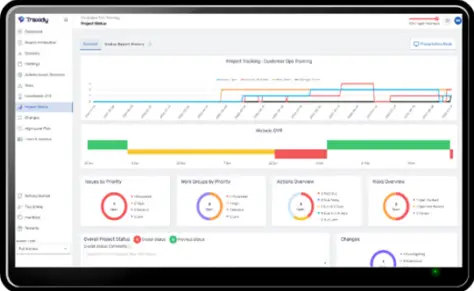
The availability of real-time critical project information is key. Automated project status reports and project dashboards will be required to track key performance indicators (KPIs). They also provide visibility to all project issues and potential changes and help key stakeholders identify areas for improvement and make informed decisions.
Project Managers require strong communication and interpersonal skills. They need to clearly communicate project goals and deadlines and set expectations with key stakeholders and team members, to ensure engagement. Most importantly, the sponsor or client needs to be engaged and involved with the project plan and the method you choose to successfully deliver your project.
In summary, Project Managers can be more successful using project tracking software with automated project tracking tools to ensure time savings, clear communications and more effective project delivery. Project Managers will benefit from taking a tailored project approach with consideration for the organizational environment and the expectations for continuous improvement. Lastly, putting a greater focus on stakeholder engagement will result in stronger alignment and more successful project delivery results.
By focusing and working more closely on these key aspects of project delivery, Project Managers can improve project planning and project control and execution, enhance stakeholder confidence, improve decision-making, and increase the likelihood of overall success for the project and themselves.
Learn more about how Traxidy project tracking software can help Project Managers save time, increase efficiency, gain project control and increase project success.
Be the first to receive our Traxidy Blog and Project Manager Insights right to your in-box.